
LHCb news before April 2010
First
30.3.2010
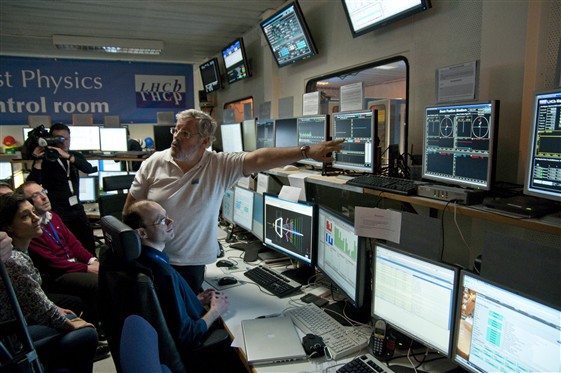
Both proton beams made a full turn of LHC on Feb. 28th. A new period of great measurements with LHCb has started again and will continue for 18-24 months. On March 18th both beams have been accelerated to 3.5 TeV,
3.5×3.5 TeV
30.3.2010
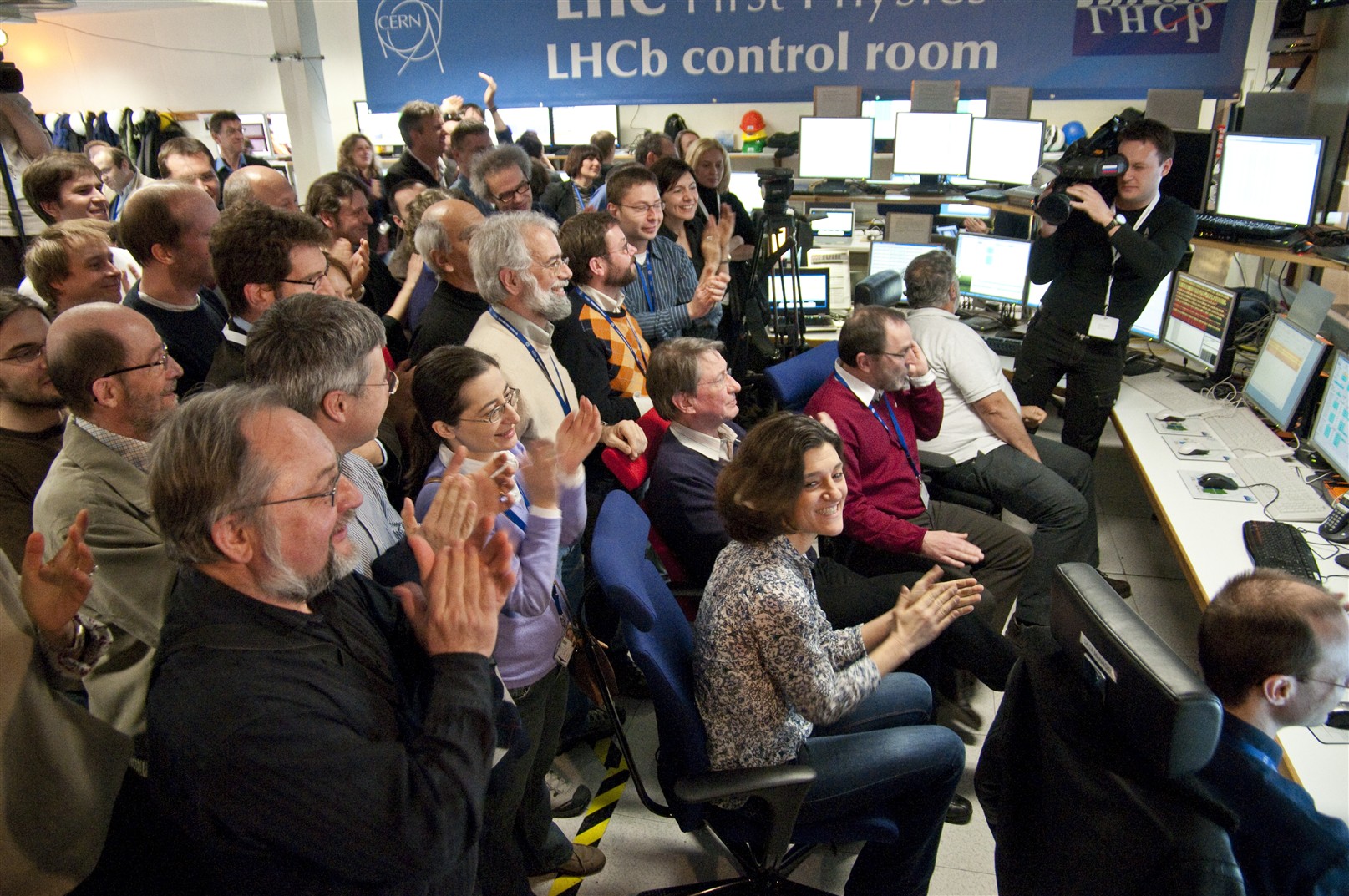
see TV footage with preparation for collisions and photo above taken just after the first collisions at 12:59 on March 30 (click on picture to get it in higher resolution).
proton-proton collisions

30.3.2010
Our first 3.5×3.5 TeV collision; other events can be found here.
/row
International
8.3.2010
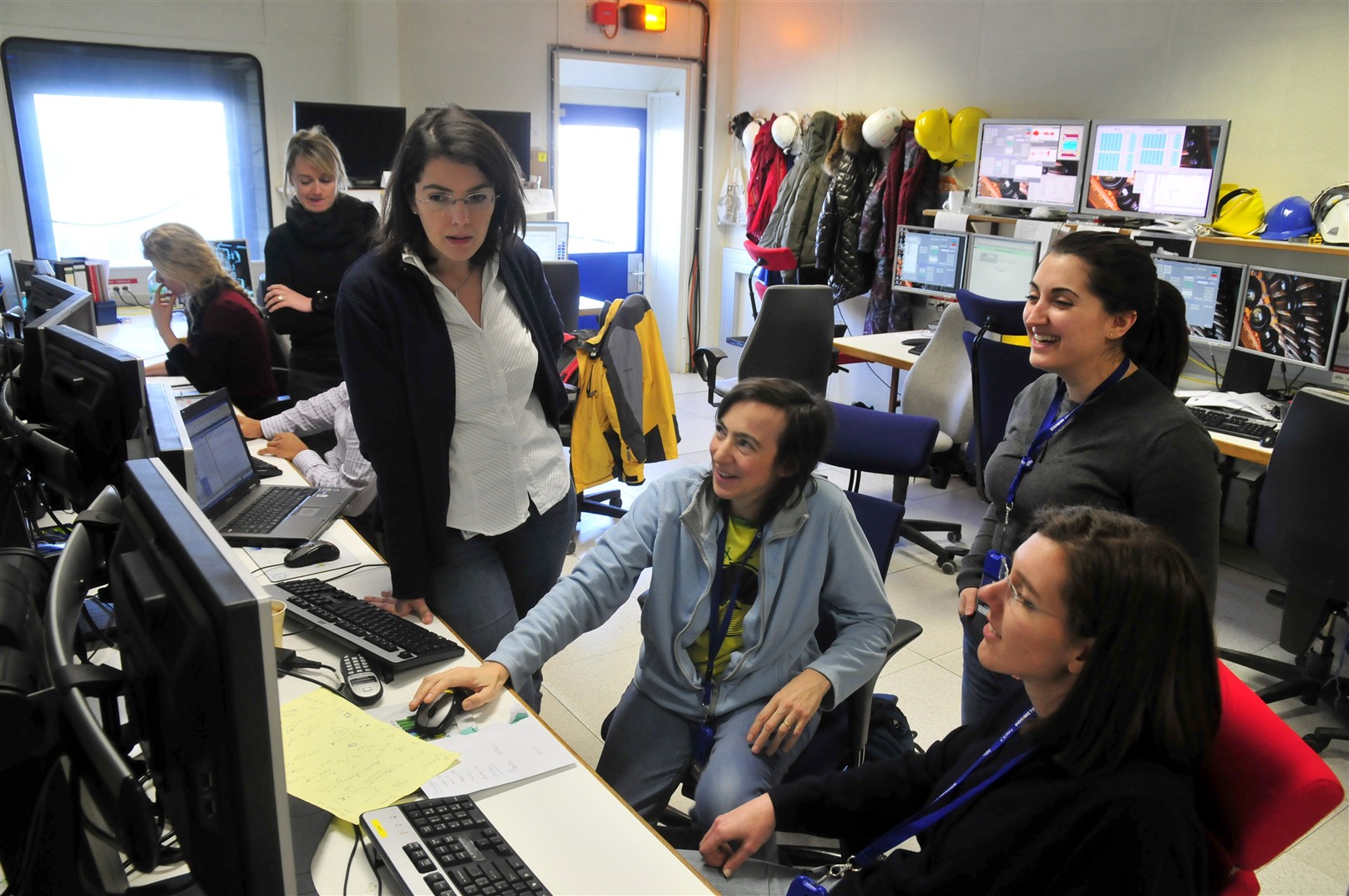
On March 8th, during during International Women's Day, many many women have been present in the LHCb control roon, …
Women's
8.3.2010
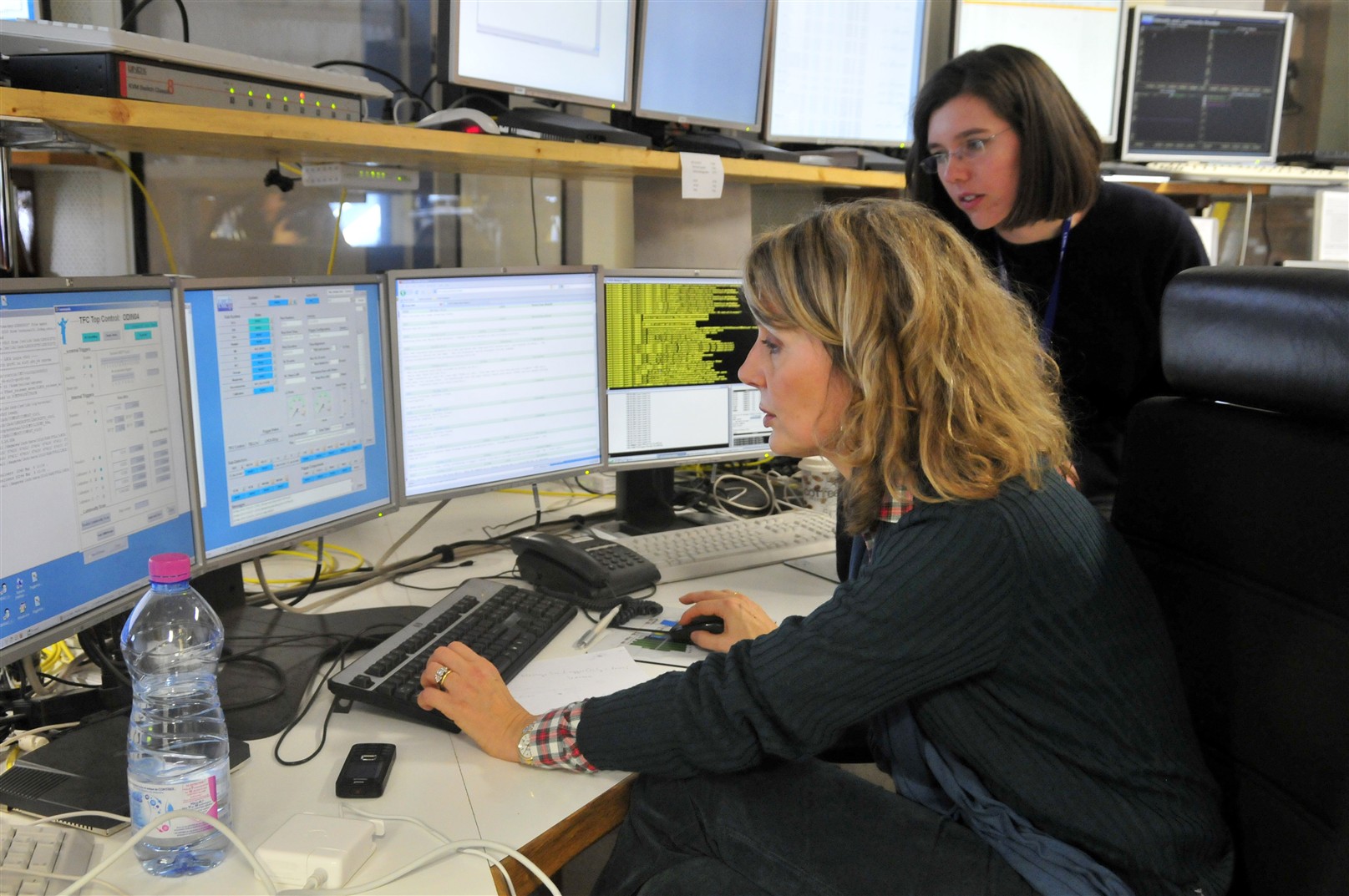
see the photos taken at the LHCb control room (click in pictures to it in higher resolution, click here to get other photos), the video interview with Monica Pepe-Altarelli here, …
Day

8.3.2010
/row
2009 News
Below you may find interesting computer reconstructed events observed with the LHCb detector during the LHC restart period in November and December 2009. Click on picture to see it in higher resolution version.
Protons have ended to circulate at LHC on December 16th.
/row
1.2 TeV collisions at LHCb

14.12.09
On December 14th 1.2 TeV proton beams have collided at LHCb during LHC machine studies. Many LHCb subdetectors, except for sensitive silicon detectors, recorded the world’s highest energy pp collisions. Other events can be found here.
proton interactions with gas

12.12.09
Position of proton interactions inside the vertex detector with residual gas are shown in blue or red, proton-proton interactions in green (more details).
K0 reconstruction

12.12.09
So called “strange particles” are produced in the proton-proton collisions and decay inside LHCb detector into two other particles reconstructed as red tracks (more details).
/row
High multiplicity events

12.12.09
A high multiplicity event with three muon tracks (green) recorded on December 12th. Other events can be found here.
More proton-proton collisions

8.12.09
On December 8th many long tracks were reconstructed using the detectors along the whole length of the LHCb. Collision vertex is clearly observed (bottom left). The tracks are curved in the magnetic field allowing measurement of the track momentum (top left). Other events can be found here.
More proton-proton collisions

6.12.09
/row
RICH rings

6.12.09
LHCb RICH detectors are used to identify particles. The circles show possible position of measured points for different kinds of particles traversing the detector. The measured points clearly choose one possibility for every circle and in this way allow to identify particles.
First proton-proton collisions

23.11.09
A proton-proton collision candidate event. On November 23 protons from two beams circulated at LHC and have collided at LHCb.
LHC news video youTube
First proton-proton collisions

23.11.09
LHCb control room at this historical moment.
/row
First proton-proton collisions

23.11.09
Tracks originate from the expected region inside LHCb Vertex Locator detector VELO.
First proton-proton collisions

23.11.09
Another proton-proton collision candidate event.
Annimation

23.11.09
Animation (click on picture): pp collisions and proton beam gas collisions recorded on Nov. 23, 2009. Other reconstructed events can be found here.
/row
First reconstructed pi0's

23.11.09
pi0 is the short lived particle decaying into two photons which were measured in the electromagnetic calorimeter ECAL. The plot above shows the nearly perfectly reconstructed pi0 mass.
First proton interactions

22.11.09
… reconstructed Vertex Locator VELO track. Other reconstructed events can be found here.
First proton interactions

22.11.09
… event reconstructed later (offline reconstruction). Particularly interesting is the blue track recorded in the Vertex Locator VELO and in the tracking chambers after the magnet.
/row
First proton interactions

21.11.09
… not yet proton-proton interaction but interactions of the protons with residual gas inside LHC ring. Tracks reconstructed during data taking.
A splash from the LHC beam

21.11.09
LHC has restarted on November 21st. Two LHC beams have made a full turn of the LHC. Afterwards, after synchronization with the LHC accelerating system (RF capture in technical language), the beams made few hundred turns. During LHC operation LHCb has recoded splash events. The movie (click on picture) shows what LHCb detector has recorded every 25ns (1/(40 000 000) s) for a particular splash event; see individual events here.
/row